Optical Neural Networks: The Dawn of Photonic AI Computing
The explosive growth of artificial intelligence has pushed traditional silicon microelectronics to the brink of physical limitations. Modern transformer architectures and trillion-parameter foundation models consume immense electrical power while generating excessive heat, threatening the sustainability of global data centers. To break through the silicon bottleneck, computer scientists and physicists have turned to a fundamentally faster medium: light. Optical Neural Networks (ONNs), powered by silicon photonics, represent a radical paradigm shift in artificial intelligence acceleration.
Breaking Moore's Law with Photons
For decades, computing advances relied on shrinking electrical transistors according to Moore’s Law. However, as transistor dimensions approach atomic scales, quantum tunneling and thermal dissipation impose rigid physical limits on clock frequencies. Transmitting electrical electrons along microscopic copper interconnects inevitably produces resistance, latency, and power waste.
Photons, by contrast, possess no electrical charge and travel at the speed of light. In an optical neural network, mathematical operations—specifically matrix multiplications that constitute the bulk of deep learning inference—are executed via the physical interference, diffraction, and phase modulation of light waves rather than electron switching.
Instantaneous Matrix Multiplication via Light
Deep learning models rely heavily on Multiply-Accumulate (MAC) calculations. In electronic GPUs, millions of logic gates switch simultaneously, draining gigawatts of power to compute these linear algebra tensors.
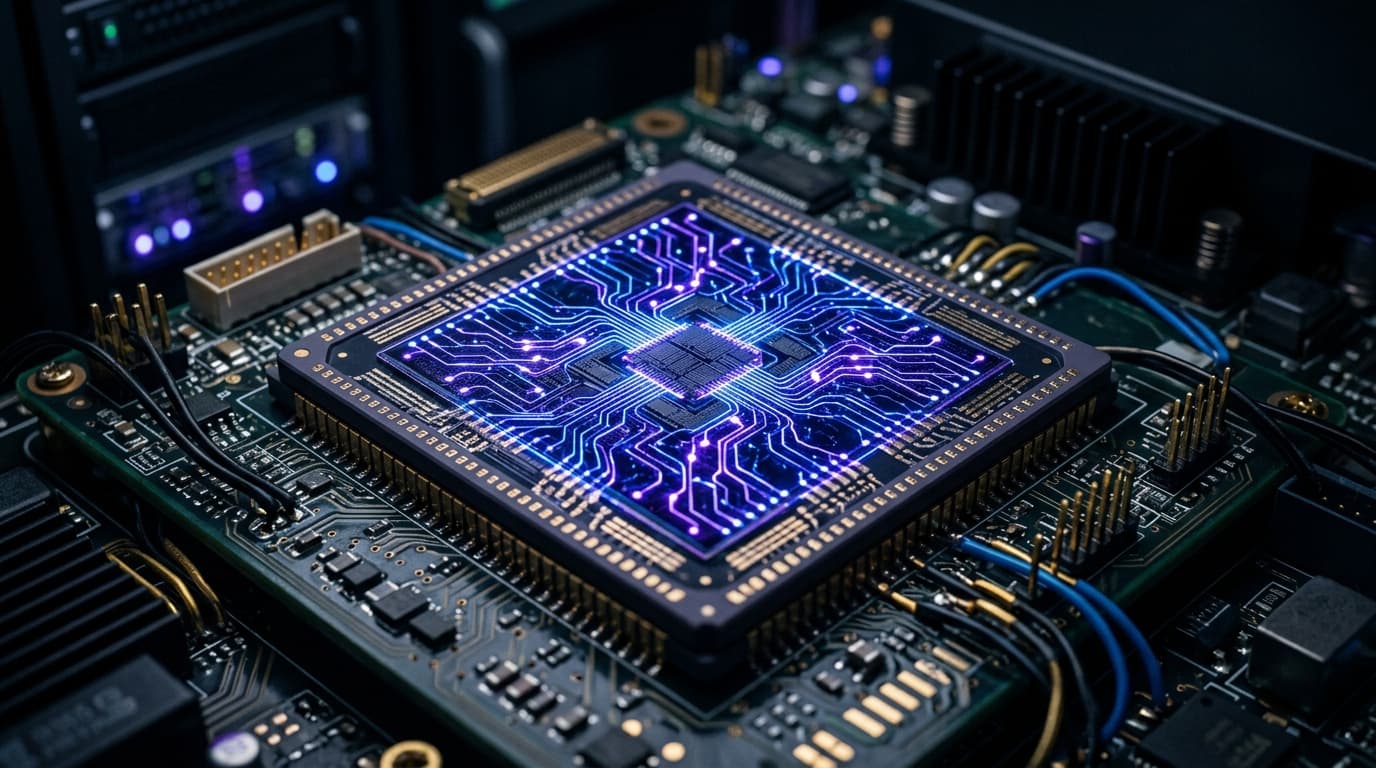
In a photonic tensor core, an array of laser beams passes through a mesh of Mach-Zehnder Interferometers (MZIs) integrated onto a silicon chip. By altering the refractive index of micro-waveguides using electro-optic materials, the circuit modulates the phase and intensity of light. When the light waves emerge from the interferometer array, the matrix multiplication has already occurred—essentially instantaneously—with near-zero heat dissipation.
Astronomical Energy Efficiency and Ultra-Low Latency
The operational advantages of optical AI computing are striking:
- Sub-Nanosecond Latency: Light travels through silicon waveguides at approximately 80,000 kilometers per second, enabling inference speeds orders of magnitude faster than copper traces.
- Wavelength Division Multiplexing (WDM): Multiple independent calculations can occur simultaneously across different colors (wavelengths) of light through a single optical waveguide without interference, achieving massive spatial parallelism.
- Drastic Thermal Reduction: Because photons do not produce electrical resistance, optical compute cores remain cold, drastically lowering the colossal cooling costs that currently dominate high-density data centers.
Co-Packaged Optics and the Path to Commercialization
While purely optical general-purpose computers remain in development, hybrid electro-photonic architectures are already finding commercial utility. Co-packaged optics (CPO) integrate photonic tensor engines alongside conventional memory controllers and CPUs. In this hybrid ecosystem, high-speed optical chips handle matrix operations, while classical digital controllers orchestrate memory access and non-linear activation functions.
As fabrication techniques in silicon foundries mature, photonic acceleration will become the foundational infrastructure for real-time edge robotics, autonomous aerospace systems, and next-generation planetary-scale AI clusters.
Frequently Asked Questions
How does an Optical Neural Network differ from an electronic GPU?
Traditional GPUs use electrical currents moving through transistors to perform mathematical calculations, which creates heat and latency. Optical Neural Networks use beams of light passing through optical modulators to calculate matrix equations almost instantly without electrical resistance.
Can optical chips run existing AI software like PyTorch and TensorFlow?
Yes. Modern photonic AI accelerators feature software compiler layers that translate standard PyTorch and TensorFlow computation graphs into optical phase configurations without requiring modifications to the original code.
When will photonic AI become standard in commercial data centers?
Hybrid electro-photonic accelerators are already entering specialized cloud facilities, with widespread commercial deployment across enterprise clusters anticipated over the next few years as silicon photonics manufacturing achieves volume parity.